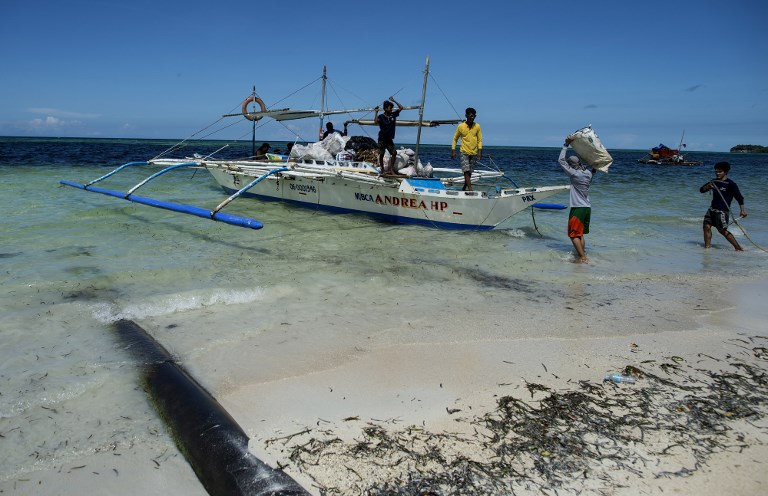
The government shuttered its most famous holiday island Boracay to tourists on Thursday, April 26, for a six-month clean-up.
Police were posted at entry points to the once-pristine island.
President Rodrigo Duterte had ordered the shutdown this month after calling the resort a “cesspool,” dirtied by tourism-related businesses dumping raw sewage directly into the ocean.
Regional police head Cesar Binag told AFP the closure began past midnight, with tourists barred from boarding the ferry that is the main way onto the island.
“Boracay is officially closed to tourists. We are not closing establishments but tourists cannot enter. We are implementing the instruction of the president,” Binag said.
About 600 policemen were deployed, with some performing life-like drills including riot officers battling bottle-hurling protesters and mock hostage taking of sunbathers.
During the closure only residents with ID cards are allowed to board ferries to the tiny island that is home to around 40,000 people.
On Thursday morning, police began patrolling the beach to enforce a rule prohibiting swimming except in one designated area marked by buoys.
Boats are barred from sailing within three kilometers (1.9 miles) of the shoreline and only Boracay residents are allowed to fish in its waters.
Resistance was light in the run-up to the closure, with no violent protests and most of the criticism focusing on the plight of laid-off staff.
The workers have been drawn by the relatively good wages on the island that has seen the number of visitors roughly quadruple to two million since 2006.
Years of unchecked growth
Those tourists, a growing number of whom are Chinese and Korean, pumped roughly $1 billion in revenue into the Philippine economy last year.
But its growth from a sleepy backpacker hideaway into a mass-tourism hub with fast food outlets on the beach has taken a toll.
Unchecked construction has eaten away at the island’s natural beauty, while slimy algae-filled waves in some areas and mountains of discarded drink bottles are problems acknowledged even by critics of the shutdown.
The government has pledged to use the closure to shore up the island’s infrastructure, bulldoze illegal structures and clean up the mess left by years of unchecked growth.
The government has billed it as a long-overdue response to a problem that is not without precedent.
Other Southeast Asian tourism destinations have also cracked down on uncontrolled tourism welcomed by locals needing income and authorities eager for development.
Thailand’s Maya Bay, made famous by the 2000 movie “The Beach” starring Leonardo DiCaprio, will be off limits for four months from June to September, officials announced last month, in a bid to save its ravaged coral reefs. Agence France Presse