


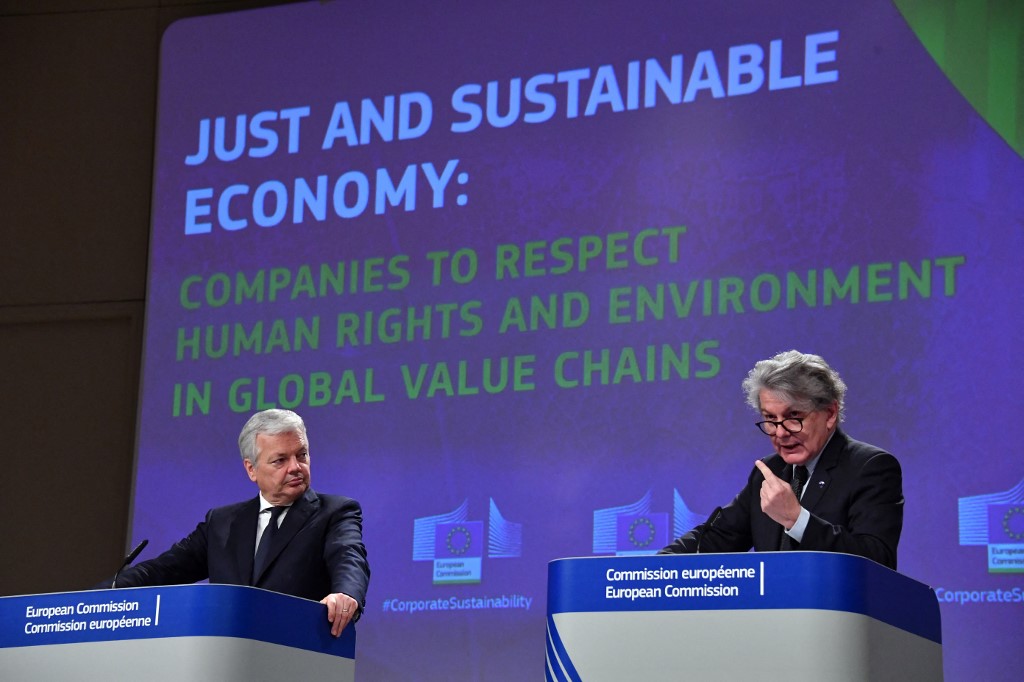
BRUSSELS, Belgium (AFP) – The EU on Wednesday presented draft legislation to force big companies to do due diligence on supply chains to ensure they do not breach human rights or environmental standards.
Those that fail to comply would face fines imposed by the EU member country they have business in.
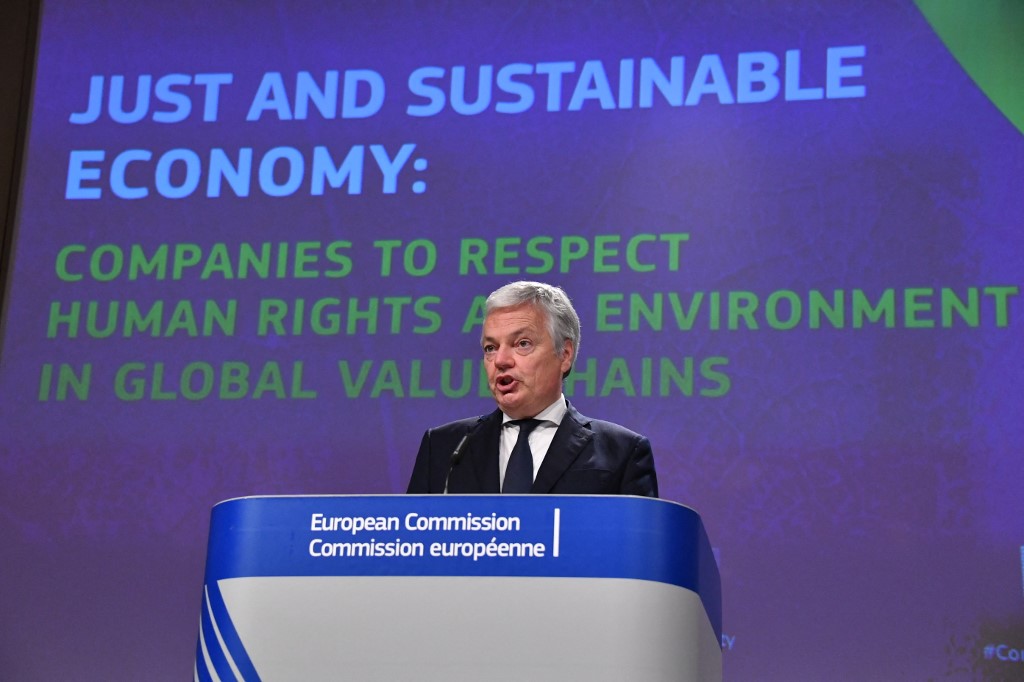
EU justice commissioner Didier Reynders said that while companies are concerned about their reputation, EU legislation is needed given the scope of the issues and to ensure “legal certainty” across the 27-nation bloc.
“This larger scale cannot be achieved with voluntary measures only. This proposal is necessary because we need to avoid fragmentation with different legislations in the different member states,” Reynders said.

The legislation would only apply to big companies.
It would cover EU ones with more than 500 employees and 150 million euros in global turnover, or those in “high impact sectors” with more than 250 employees and 40 million euros in turnover.
It would also cover non-EU companies “active in the EU” with the same turnover thresholds “generated in the EU”.
It would be incumbent on them to identify potential human rights or environmental problems in their value chains or subsidiaries, and to end or mitigate them.
Companies would need to issue communications on how they are meeting these requirements at least on an annual basis. And member states would have to designate an authority to ensure enforcement.
The proposed EU law reflects legislation already in place in France since 2017, and in preparation in several other member countries, including Germany, Austria and the Netherlands.
“The aim here is not to make investment more difficult, rather to make it possible for companies to better manage the risks that they face, including in other countries,” Reynders said.
While the European Parliament has called for the measures to go further, notably by covering smaller companies, the proposal was generally welcomed.
It is “important for Europe and, with time, hopefully even for the world,” said one centre-left Dutch MEP, Lara Wolters.
“We have an internal market of 450 million consumers. And I think we need to use the leverage of that market to make a difference,” she told AFP.
But another MEP, Anna Cavazzini of Germany, complained it “lacked ambition” and would exclude many companies in the agri-food and textiles sectors where labour rights violations proliferate.
Charles-Henri Boeringer, a lawyer at the firm Clifford Chance, said the commission had opted for a “more proportionate approach” than the one the parliament had argued for, one that tracked closely to French law.
© Agence France-Presse