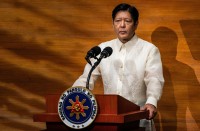
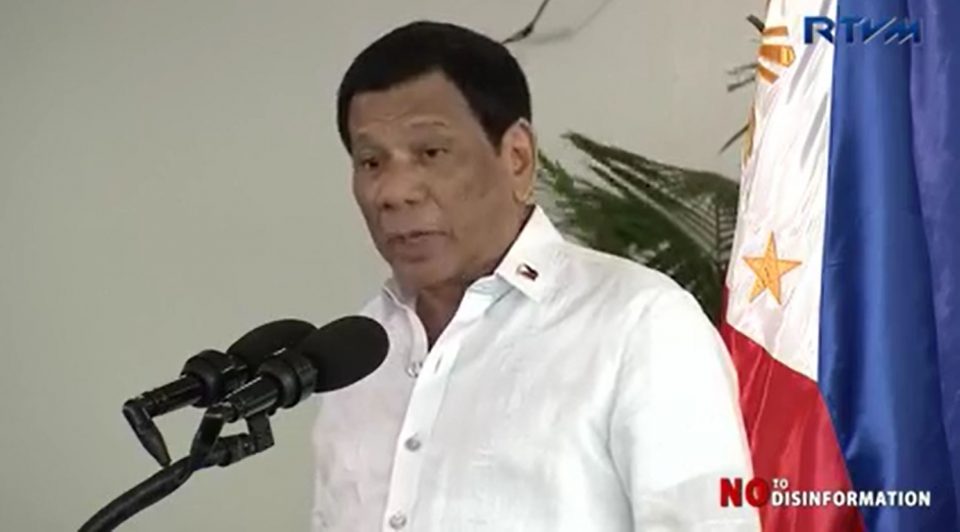
(Eagle News) – President Rodrigo Duterte said that he would follow whatever the Supreme Court will decide on the matter of the amnesty granted to Senator Antonio Trillanes IV, even as he insisted that the amnesty was “fatally flawed” and void from the start.
Speaking shortly after his arrival from Israel and Jordan on Saturday, Sept. 8, 2017, the President said he has to answer the questions from the media even if he has had no sleep.
Duterte also disregarded claims by his critics and the opposition that his administration was implementing a de facto martial rule just because he had issued a proclamation that voided Trillanes’ amnesty, saying he was just implementing the law, and that he will follow judicial processes.
He said Trillanes, whom he branded as “corrupt” need not fear of any arrest if there is no warrant issued by the civilian court.
“Now if the Supreme Court says that my proclamation is invalid, then let it fall,” he said after arriving from his successful trip to Israel and Jordan on Saturday, Sept. 8.
-Trillanes, “pretending to be a crusading soldier,” says Duterte-
Duterte also criticized Trillanes for “pretending to be a crusading soldier.”
“I hope that it would not get to this part. We never started the ruckus. It was Trillanes pretending to be a crusading soldier, when as a matter of fact wala naman siyang nagawa.”
“He not only abandoned the vision of the military, he became a corrupt guy collecting dyan sa mga negosyante (businessmen). Para syang abogado. Alam namin yan kasi ang negosyante kahit paano mo taguin, nagsasalita talaga yan. (He is like a lawyer. We know that because even if you try to hide that, those businessmen will really talk), ” Duterte said.
The President also cited a newspaper column on Trillanes, saying “he has no honest bone in his body.”
Duterte explained that Trillanes’ release from the custody of the military in 2010 when he was still facing court martial proceedings was “flawed” since the amnesty granted to him was also “void.”
-“Flawed document”-
“In the first place the amnesty allowing his release was void. Therefore his getting out of the custody was also void. Walang basis e. (There is no basis) Kasi yung amnesty was defective. Fatally flawed, yung basis ngayon ng release niya (is void) based on that fatally flawed document. Mango tree is mango tree. Nothing valid could come out from a void document,” he said.
Duterte said that if he can be allowed to argue before the Supreme Court, he will say: “Baklit na-release yan. Because of this (amnesty). You think this is valid?”
But he said the matter is now with the Supreme Court.
“Nandyan na sa Supreme Court, we leave it at that. If am affirmed or sustained, it’s now the military (who will handle Trillanes),” Duterte said.
“Sila naman ang naghawak sa kanyang last.. Bahala sila (They are the ones who held him last. Let them be the one to handle him),” he said.
-Duterte: Calida did the “research” on Trillanes’ case-
The President also revealed that it was Solicitor General Jose Calida who did the “research” on the amnesty granted to Trillanes.
“Look I am here to enforce the law. Yung kay Trillanes, ang totoo niyan ang nag-research si Calida,” he said.
“Pag sinabi ng Solgen na may mali (If the Solgen says there is something wrong) and it has to be corrected, I cannot refuse, he is the government lawyer,” Duterte said.
Calida was also responsible for the quo warranto petition that eventually voided the appointment as Supreme Court chief justice of Maria Lourdes Sereno.
The President said that he signed Proclamation No. 572 because he also believed what Calida had found out – that the amnesty was “void ab initio” or void from the start.
-Requirements for the grant of amnesty-
Duterte said that while it is true that the President of the Philippines has the power and “constitional mandate” to grant pardon and amnesty, there were certain requirements lacking in Trillanes’ amnesty.
He said that Trillanes has failed to do his “admission of guilt” in written form, which should be a detailed narrative of his wrong actions.
“He has to do it in writing. Look we have to determine criminal liability first,” the President said.
“Before you can give a pardon or amnesty, you have to declare your guilt and place it on a narrative. You think you can just play around the Constitution? It must be in affidavit form, and you narrate kung ano ang kasalanan mo,” he said.
Duterte also said that there should also be a particular place inside the office of the Armed Forces of the Philippines where the requirements for amnesty should be completed.
“Ang problema dyan, may mga requirements (The problem there is that there are requirements). One is that you have to do it in the particular office in the Armed Forces of the Philippines organization. It has to be J1, administrative,” he explained.
He also scored what he claimed was the error of former Defense Secretary Voltaire Gazmin in being the person recommending the amnesty of Trillanes and the other Magdalo soldiers, and then being the same person to approve this.
“The power to pardon and the power to grant amnesty with the concurrence of Congress is a presidential power. It cannot be delegated to anybody else. Constitutional mandate yan,” Duterte said.
But the President said that he would not delve further into the merits of the case anymore since Trillanes has already filed his petition with the Supreme Court.
The senator had asked the high court to issue a temporary restraining order (TRO) that will prevent him from being arrested after President Duterte, through Presidential Proclamation 572, voided the amnesty granted to him by former President Benigno Aquino III in 2010.
President Duterte, however, said that there would be no arrest made without a warrant of arrest issued by a civilian court, or the regional trial court where the case of coup d’etat and rebellion against Trillanes had been lodged.
(Eagle News Service)