
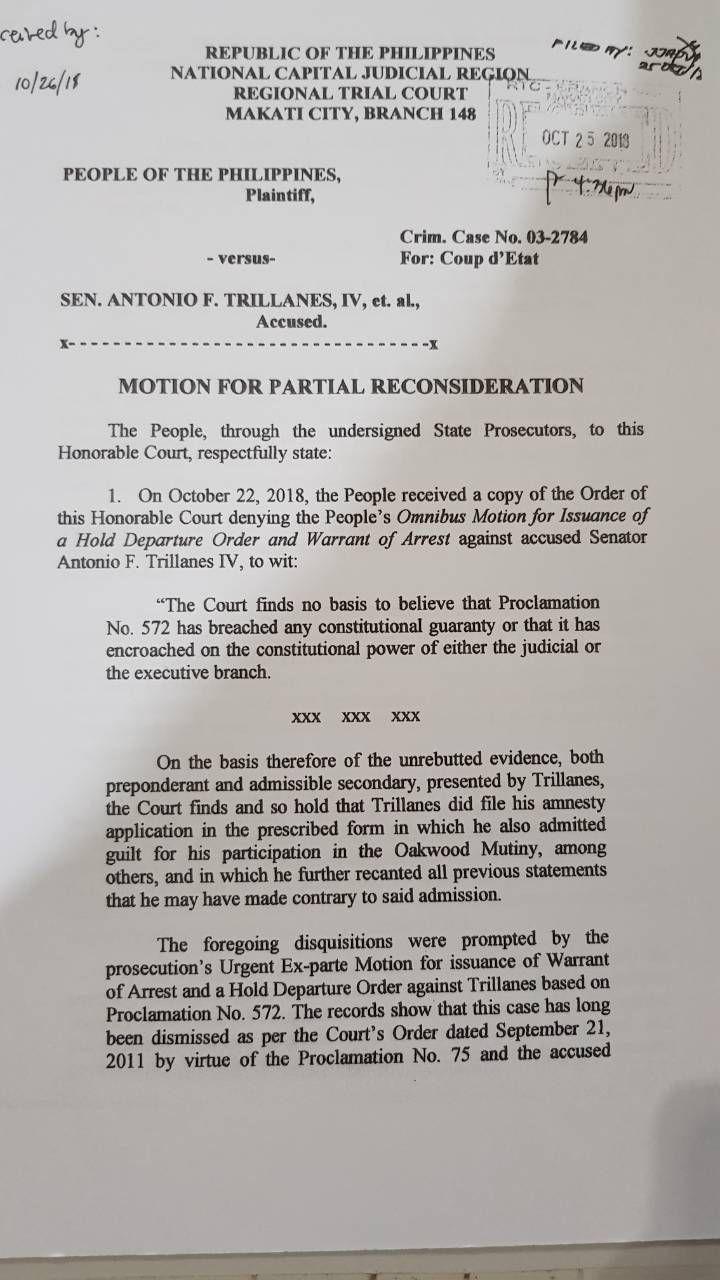
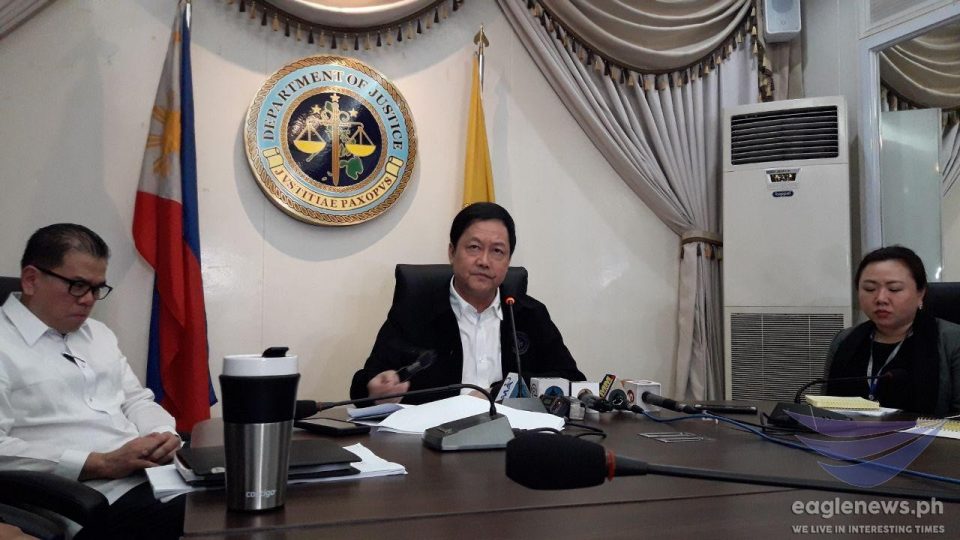
(Eagle News) – The Department of Justice has filed its motion for partial reconsideration with the Makati Regional Trial Court branch 148, seeking a partial reversal of its ruling on the non-issuance of an arrest warrant for Senator Antonio Trillanes IV.
The DOJ’s motion was filed on Thursday, Oct. 25 at 4:30 p.m., according to Justice Secretary Menardo Guevarra on Friday, Oct. 26.
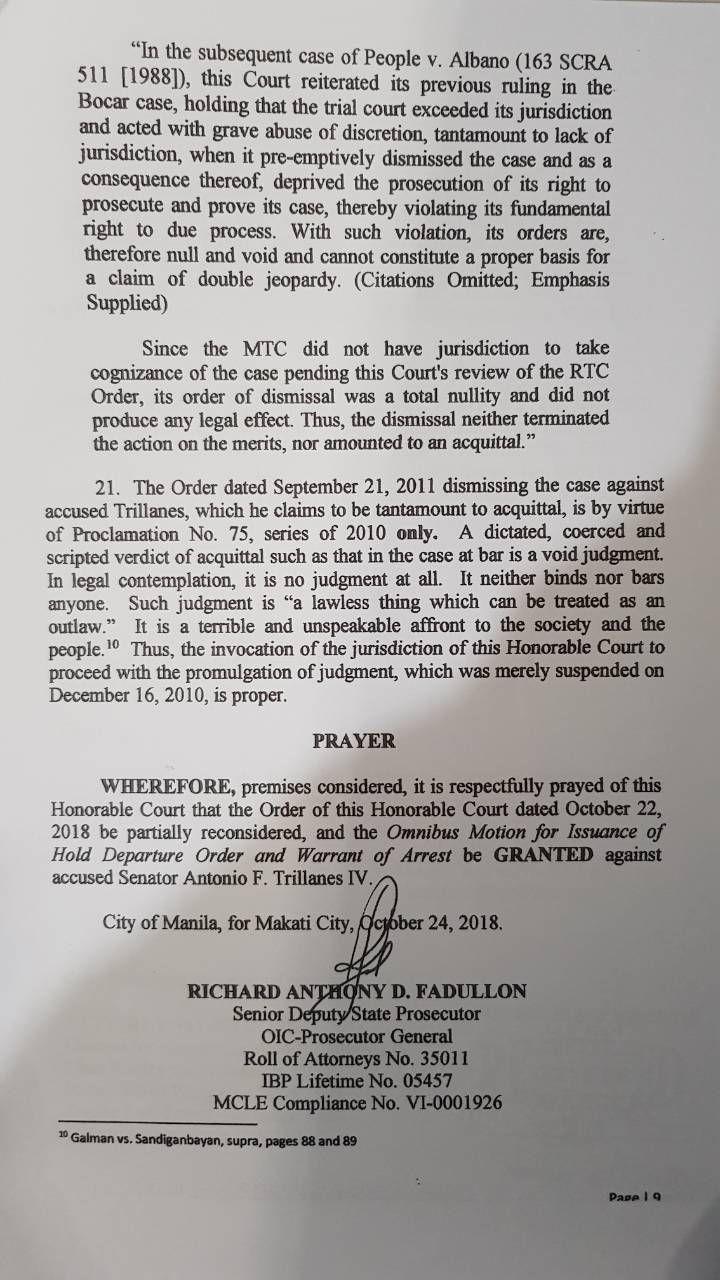
With the filing of the motion, the DOJ is asking the Makati court to review its Oct. 22 decision and grant the department’s previous motion to issue an arrest warrant and a hold departure order against Trillanes.
In the DOJ’s motion, Acting Prosecutor General Richard Anthony Fadullon said that Makati RTC branch 148 Judge Andres Soriano “erroneously disregarded the factual bases for the issuance” of President Rodrigo Duterte’s Proclamation No. 572 even though he “correctly ruled” on its legality.
“The Honorable Court also erred in ruling that its Oder od Dismissal of the case against accused Trillanes dated September 21, 2011, has become final and executory and therefore immutable,” said Fadullon in the DOJ’s motion.
The DOJ, in its motion, said that the Makati court “contradicted itself when it made wrongful findings as to the factual bases” of Duterte’s Proclamation No. 572.
It pointed out that there was a presumption that the President had already determined that Trillanes did not comply with the requirements for the grant of amnesty, which include the filing of the amnesty application form, as well as the admission of guilt and recantation.
“In wrongfully concluding that accused Trillanes did apply for amnesty, admitted guilt and recanted previous inconsistent statement contrary to the said admission, the Honorable Court practically disregarded the credible evidence presented by the People, both testimonial and documentary,” the DOJ’s motion read.
It said Judge Soriano, instead “took as gospel truth the testimonies of defense witnesses.”
Among the defense witnesses presented by Trillanes’ camp were Lt. Col. Josefa Berbigal, former defense undersecretary Honorio Azcueta, and Trillanes’ fellow Magdalo soldiers Dominador Rull and Emmanuel Tirador.
The DOJ said that Trillanes’ witnesses had biased testimonies and were “not supported by evidence.”
“Instead of being cited as credible witnesses, their testimonies should not have been given weight at all,” its motion said.
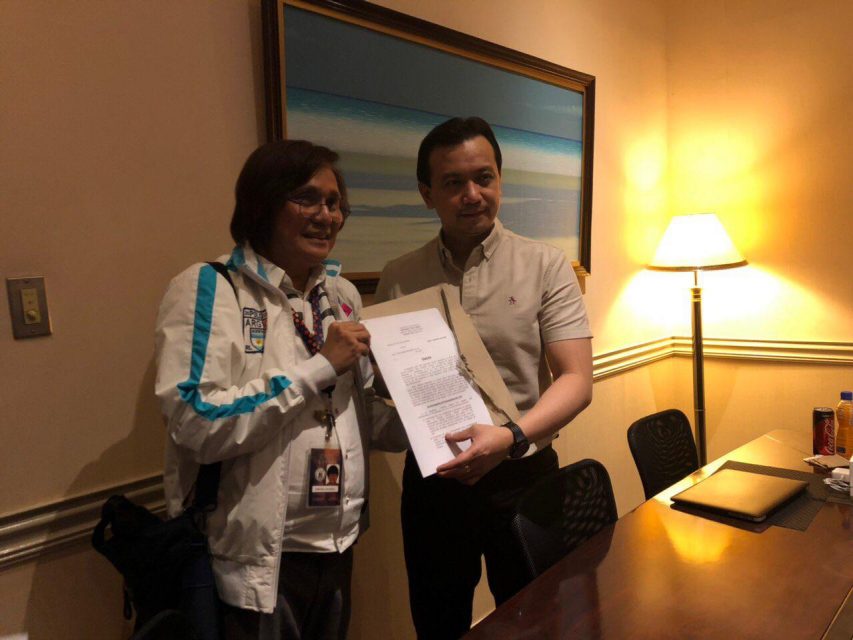
The DOJ also noted that the government offices where Trillanes’ supposed application for amnesty should be filed and kept, had no record of his application form for amnesty.
These are the J1 of the Armed Forces of the Philippines, the DND Records Division, and the Office of the Undersecretary for Defense Affairs.
The witnesses from these offices are “more credible as they were made based on the records of their offices and not on some selective recollection of seemingly confused and biased witnesses,” the DOJ said in its motion.
It also pointed out that the DND Ad Hoc committee that processed the application of amnesty by Trillanes despite his public pronouncements denying the admission of guilt immediately after filing it, and recommending the grant of amnesty to him, had “committed grievous errors.”
The absence of any appeal or opposition to Trillanes’ amnesty before does not mean that this appeal cannot be voided, the DOJ’s appeal said.
It also stressed that the Makati court’s earlier ruling dismissing the coup d’etat case against Trillanes on Sept. 21, 2011 was “void.”
“This therefore is not a final and executory judgment,” the DOJ’s motion for partial reconsideration said.